
Palm Kernel Oil
Palm kernel oil comes from the seed inside oil palm fruit. Its firm texture suits confectionery coatings, fillings and other prepared foods. It differs from palm oil, which comes from the fruit flesh. Palm kernel oil is high in saturated fat.
Also known as
palm kernel oil · palm kernel fat · refined palm kernel oil
Why PRūF tracks it
The review considers the cholesterol effects of its high saturated-fat content and possible processing contaminants, while evidence from mixed fats, heavily reheated oils or animal experiments does not establish harm from a particular serving.
Read the research
Palm kernel oil contains mostly saturated fats, especially lauric and myristic acids. It is different from palm fruit oil and from concentrated medium-chain triglyceride products, so their study results cannot simply be exchanged. Its main concern is nutritional: replacing less saturated oils with lauric-rich fats can raise blood cholesterol. Small controlled feeding studies using palm-kernel-rich blends found higher cholesterol than some comparison fats, but they did not measure heart attacks or establish the effect of every commercial product.
HDL cholesterol can rise alongside other cholesterol measures; that does not establish a cardiovascular benefit. A recent meal study of mixed spreads found no clear differences in several short-term vascular or inflammatory measures, but it could not isolate palm kernel oil. Processing may also introduce 3-MCPD and glycidyl esters, contaminants linked to kidney, reproductive or cancer effects in animal research. A small Ghanaian market study measured both contaminants in artisanal palm kernel oils, with substantial variation.
Repeated frying can degrade the oil, although laboratory quality measurements do not establish a universally safe number of reuses. EU contaminant limits apply, including tighter limits for specified baby-food uses from January 2027. Neither those limits nor ordinary ingredient-label rules amount to a broad food ban.
Research reviewed on September 5, 2026 · 12 sources
Matches
1–12 of 202 matches
 (4) Cinn-a-Stack PancakesIHOP · Updated September 23, 2026
 (4) Cupcake PancakesIHOP · Updated September 23, 2026
- (4) Pumpkin Spice PancakesIHOP · Updated September 23, 2026
 12 oz. Ft. Worth Ribeye & Grilled ShrimpTexas Roadhouse · Updated September 23, 2026
 12 oz. Strip & Grilled Shrimp (in selected stores only)Texas Roadhouse · Updated September 23, 2026
 6 oz. Sirloin & Grilled ShrimpTexas Roadhouse · Updated September 23, 2026
 8 oz. Sirloin & Grilled ShrimpTexas Roadhouse · Updated September 23, 2026
 8 oz. Strip & Grilled Shrimp (in selected stores only)Texas Roadhouse · Updated September 23, 2026
 All-American CheeseburgerTexas Roadhouse · Updated September 23, 2026
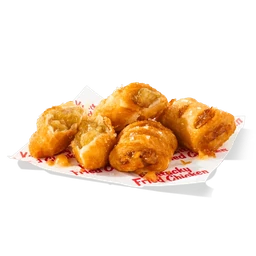 Apple Pie PoppersKFC · Limited Time Offers · Updated September 6, 2026
 Apple TurnoverArby's · Updated September 23, 2026
 Bacon CheeseburgerTexas Roadhouse · Updated September 23, 2026
Research sources
The published research used in the PRūF app.
- Standard for Named Vegetable Oils, CXS 210-1999
Codex Alimentarius · 2026 edition, including July corrigendum · Accessed 2026-09-05
- WHO updates guidelines on fats and carbohydrates
World Health Organization · 2023-07-17 · Accessed 2026-09-05
- Comparison of the effects of diets enriched in lauric, palmitic, or oleic acids on serum lipids and lipoproteins in healthy women and men
Temme et al. / American Journal of Clinical Nutrition · 1996-06 · Accessed 2026-09-05
- Fat high in stearic acid favorably affects blood lipids and factor VII coagulant activity in comparison with fats high in palmitic acid or high in myristic and lauric acids
Tholstrup et al. / American Journal of Clinical Nutrition · 1994-02 · Accessed 2026-09-05
- Postprandial lipid and vascular responses following consumption of a commercially-relevant interesterified palmitic acid-rich spread in comparison to functionally-equivalent non-interesterified spread and spreadable butter
Hall et al. / Food & Function · 2024 · Accessed 2026-09-05
- Triglyceride (Palmkernöl)
DFG MAK Commission · 2025-06-30 · Accessed 2026-09-05
- Occurrence of 3-monochloropropane-1,2-diol and glycidyl esters in artisanal vegetable edible oils
Yabani et al. / Heliyon · 2024 · Accessed 2026-09-05
- Thermal Degradation and Safety of Repeatedly Heated Palm Kernel Oil During Deep Frying
Mensah and Kudomor / Food Safety and Health · 2025-09-16 online; 2026 issue · Accessed 2026-09-05
- 3-Monochloropropane-1,2-diol (MCPD) Esters and Glycidyl Esters
US Food and Drug Administration · Current page including 2021-2023 monitoring · Accessed 2026-09-05
- Commission Regulation (EU) 2026/1825: maximum levels of 3-MCPD, its esters and glycidyl esters in certain foods
European Union · Adopted 2026-07-29; published 2026-07-30 · Accessed 2026-09-05
- Common Names for Ingredients and Components
Canadian Food Inspection Agency · 2026-05-27 modification date · Accessed 2026-09-05
- 21 CFR 101.4: Food; designation of ingredients
eCFR / United States · Current text inspected 2026-09-05 · Accessed 2026-09-05
Know your food.
Anywhere.
Explore restaurant ingredients and nutrition in the PRūF iPhone app.